
Turner Syndrome
What is Turner Syndrome ?
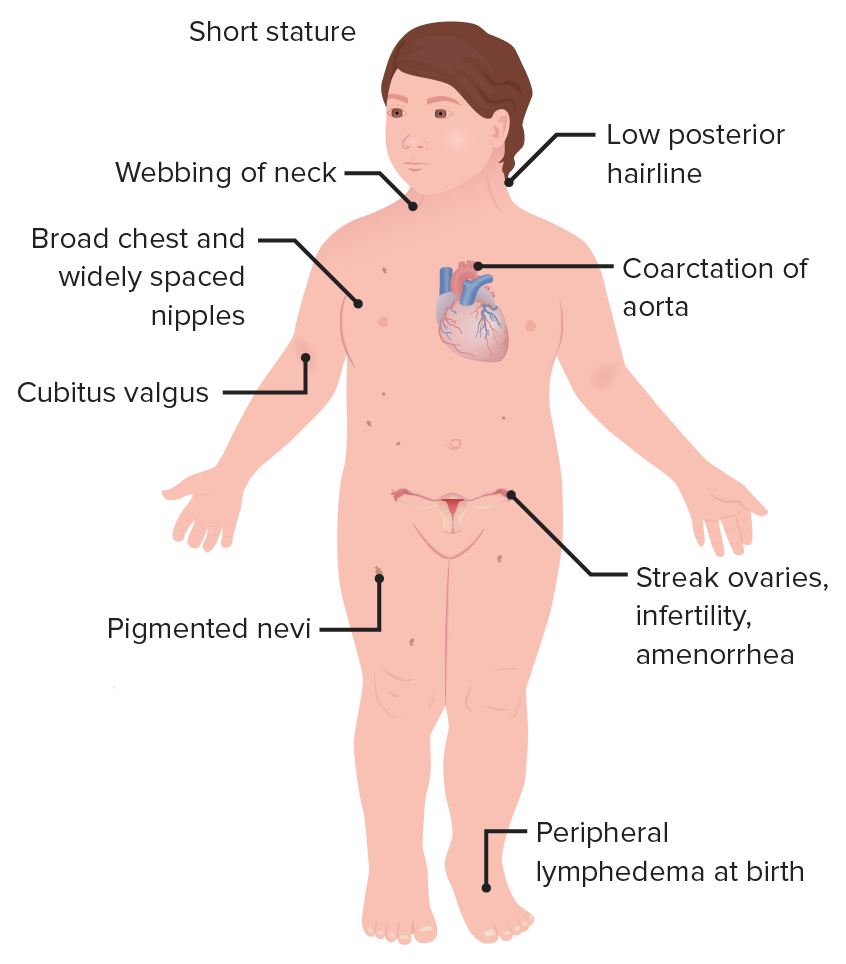
Turner syndrome, a condition that affects only females, results when one of the X chromosomes (sex chromosomes) is missing or partially missing. Turner syndrome can cause a variety of medical and developmental problems, including short height, failure of the ovaries to develop, and heart defects.
Turner syndrome may be diagnosed before birth (prenatally), during infancy, or in early childhood. Occasionally, in females with mild signs and symptoms of Turner syndrome, the diagnosis is delayed until the teen or young adult years. Girls and women with Turner syndrome need ongoing medical care from a variety of specialists. Regular checkups and appropriate care can help most girls and women lead healthy, independent lives.
Symptoms
- Large fluid collection on the back of the neck
- Heart abnormalities
- Abnormal kidneys
- Wide or weblike neck
- Low-set ears
- Broad chest with widely spaced nipples
- High, narrow roof of the mouth
- Arms that turn outward at the elbows
- Swelling of the hands and feet, especially at birth
- Slightly smaller than average height at birth
- Slowed growth
- Low hairline at the back of the head
Cause
Most people are born with two sex chromosomes. Males inherit the X chromosome from their mothers and the Y chromosome from their fathers. Females inherit one X chromosome from each parent. In females who have Turner syndrome, one copy of the X chromosome is missing, partially missing, or changed. The genetic changes of Turner syndrome may be one of the following: Monosomy, the complete absence of an X chromosome generally occurs because of an error in the father’s sperm or in the mother’s egg. This results in every cell in the body having only one X chromosome. Mosaicism, in some cases, is an error that occurs in cell division during early stages of fetal development. This results in some cells in the body having two complete copies of the X chromosome. Other cells have only one copy of the X chromosome. X chromosome changes: Changed or missing parts of one of the X chromosomes can occur. Cells have one complete and one altered copy. This error can occur in the sperm or egg, with all cells having one complete and one altered copy. Or the error can occur in cell division in early fetal development, so that only some cells contain the changed or missing parts of one of the X chromosomes (mosaicism). Y chromosome material. In a small percentage of Turner syndrome cases, some cells have one copy of the X chromosome, and other cells have one copy of the X chromosome and some Y chromosome material. These individuals develop biologically as females, but the presence of Y chromosome material increases the risk of developing a type of cancer called gonadoblastoma.
Risk Factors
The loss or alteration of the X chromosome occurs randomly. Sometimes, it’s because of a problem with the sperm or the egg, and other times, the loss or alteration of the X chromosome happens early in fetal development. Family history doesn’t seem to be a risk factor, so it’s unlikely that parents of one child with Turner syndrome will have another child with the disorder.
When to see a Doctor
Sometimes it’s difficult to distinguish the signs and symptoms of Turner syndrome from other disorders. It’s important to get a prompt, accurate diagnosis and appropriate care. See your doctor if there are concerns about the possibility of Turner syndrome. Your doctor may refer you to a physician who specializes in genetics (geneticist) or hormone disorders (endocrinologist) for further evaluation.