
Cholesteatoma
What is Cholesteatoma ?
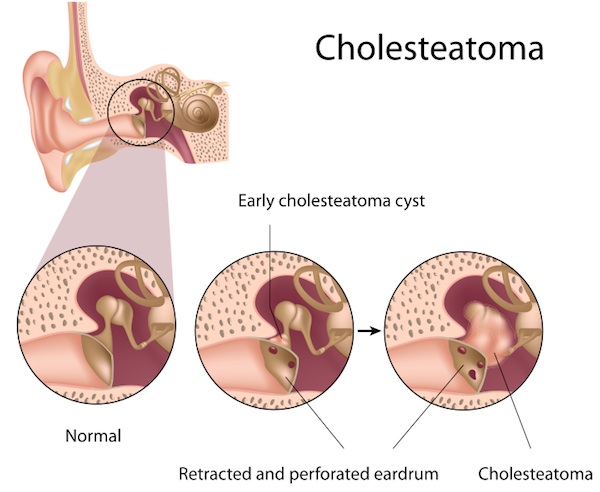
A cholesteatoma is a growth behind your eardrum (tympanic membrane). It develops when dead skin cells gather behind your eardrum to form a lump or cyst that may look like a pearl. You can be born with a cholesteatoma, but it usually happens because you have a retracted eardrum or a ruptured eardrum.
Without treatment, cholesteatomas may become infected or grow large enough to damage your hearing and facial nerve. Surgery to remove the growth is the only way to treat a cholesteatoma.
Symptoms
- Constant sound inside your ear
- Dizziness
- Ear infection
- Earache
- Feeling of "fullness" in one ear
- Fluid that smells bad and leaks from your ears
- Trouble hearing in one ear
- Weakness in half your face
- Tinnitus
- Facial muscle weakness
Cause
One of the main causes is a retracted eardrum. This is when there’s an imbalance between the air inside and outside of your ear. This causes your middle ear to pull in your eardrum. When that happens, you may develop a cyst or pocket that fills up with skin cells and becomes a cholesteatoma. Chronic ear infections (acute otitis media) or ruptured eardrums can also lead to cholesteatomas. Rarely are children born with the condition.
Risk Factors
Cholesteatoma, a noncancerous skin growth in the middle ear, can develop due to several risk factors. These include chronic or recurrent middle ear infections, eustachian tube dysfunction, and previous ear surgeries or trauma. Congenital cholesteatomas, present at birth, are less common. Prolonged or repeated ear infections can lead to the eardrum retracting and creating a pocket where skin cells can accumulate and form a cholesteatoma. The eustachian tube helps regulate pressure and drain fluid from the middle ear. If it doesn’t function properly, it can create negative pressure in the middle ear, causing the eardrum to retract and increasing the risk of cholesteatoma. Surgical procedures on the middle ear or injuries to the eardrum can create openings or pockets where skin can migrate and form a cholesteatoma. In rare cases, individuals are born with a cholesteatoma due to abnormal development of the middle ear. A retracted eardrum (pushed inward) or a hole in the eardrum (perforation) can allow skin cells to enter the middle ear and contribute to cholesteatoma development. While cholesteatomas can occur at any age, they are more commonly diagnosed in children and young adults due to the higher incidence of ear infections during these periods. Allergic rhinitis, upper respiratory infections, and sinusitis can also contribute to eustachian tube dysfunction and potentially increase the risk of cholesteatoma.
When to see a Doctor
Make an appointment with your doctor if you have any signs and symptoms that worry you.