
Amniotic Band Syndrome
What is Amniotic Band Syndrome ?
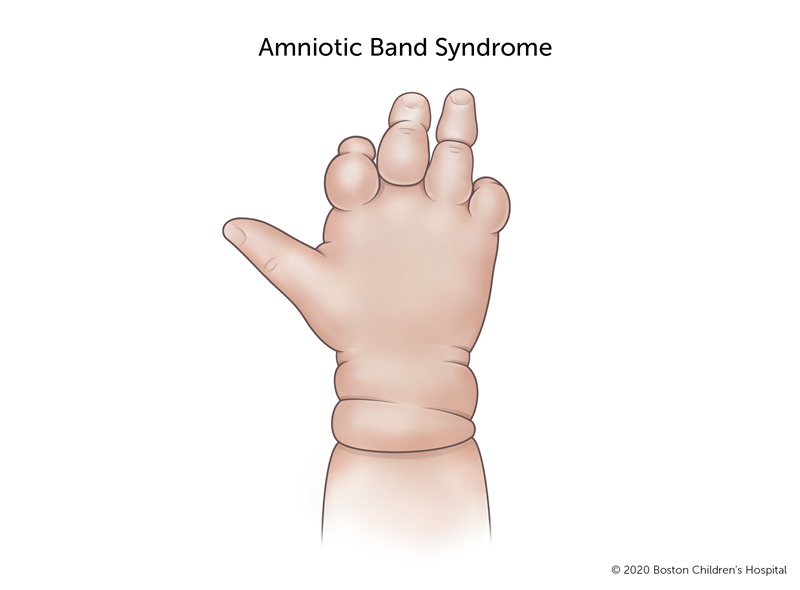
Amniotic band syndrome is a well-known condition potentially associated with a variety of different birth defects. The abnormalities occur after the affected parts of the body have formed normally in early development. The severity of amniotic band syndrome can range from a single, isolated finding to multiple, disfiguring complications. The arms and legs are most often affected. The head and face and, in some patients, various internal organs can also be affected. The exact cause of amniotic band syndrome is unknown and controversial.
Two main theories have been proposed to explain the development of the disorder. One theory attributes the disorder to causes that arise internally within the fetus (intrinsic theory); the other theory attributes the disorder to causes acting upon the fetus externally (extrinsic theory). It is likely that both internal and external factors can cause the amniotic band syndrome, and that the cause of the disorder in one infant may be different from the cause in another infant.
Symptoms
- Missing fingers, toes or limbs
- Syndactyly (webbing or fusion between fingers or toes)
- Shortened or underdeveloped limbs
- Swelling in the areas affected by the bands
- Clubfoot
- Cleft lip and cleft palate
- Bone deformities, including scoliosis
- Choanal atresia (underdeveloped nasal passage)
- Microphthalmia (small or underdeveloped eyeballs)
- A difference in the length of their arms or legs
Cause
Most research shows that amniotic band syndrome has no clear cause other than damage that occurs to the amnion (the lining of the amniotic sac). Causes of amniotic sac damage may include Prenatal tests such as chorionic villus sampling (CVS) or amniocentesis. These tests puncture the amniotic sac with a needle to get a sample of fluid or tissue from the fetus. Damage from these tests is rare. Open fetal surgery. This is for serious, life-threatening fetal conditions only. But in some cases of ABS, the amniotic sac is intact and not the cause. So, other experts believe ABS is the result of circulation (blood flow) problems in the fetus. Some fetuses may have an abnormal gene that makes them more likely to have poor circulation.
Risk Factors
You may be more likely to have a fetus with ABS if you have pregnancy complications. Have vascular Ehlers–Danlos syndrome. Smoke during pregnancy. Use drugs that aren’t prescribed to you or take certain medications during pregnancy.
When to see a Doctor
It is typically very difficult to detect amniotic band syndrome before birth, but the condition can sometimes be detected via ultrasound. Many times, amniotic band syndrome is diagnosed after delivery during a physical examination of the newborn.