
Creutzfeldt-Jakob Disease
What is Creutzfeldt-Jakob Disease ?
Creutzfeldt-Jakob (KROITS-felt YAH-kobe) disease, also known as CJD, is a rare brain disorder that leads to dementia. It belongs to a group of human and animal diseases known as prion disorders. Symptoms of Creutzfeldt-Jakob disease can be similar to those of Alzheimer’s disease. But Creutzfeldt-Jakob disease usually gets worse much faster and leads to death.
Creutzfeldt-Jakob disease (CJD) received public attention in the 1990s when some people in the United Kingdom became sick with a form of the disease. They developed variant CJ, known as vCJD, after eating meat from diseased cattle. However, most cases of Creutzfeldt-Jakob disease haven’t been linked to eating beef. All types of CJD are serious but are very rare. About 1 to 2 cases of CJD are diagnosed per million people around the world each year. The disease most often affects older adults.
Symptoms
- Personality changes
- Memory loss
- Impaired thinking
- Blurry vision or blindness
- Insomnia
- Confusion and disorientation
- Problems with coordination
- Trouble speaking
- Trouble swallowing
- Sudden, jerky movements
- Seizures
- Paralysis
Cause
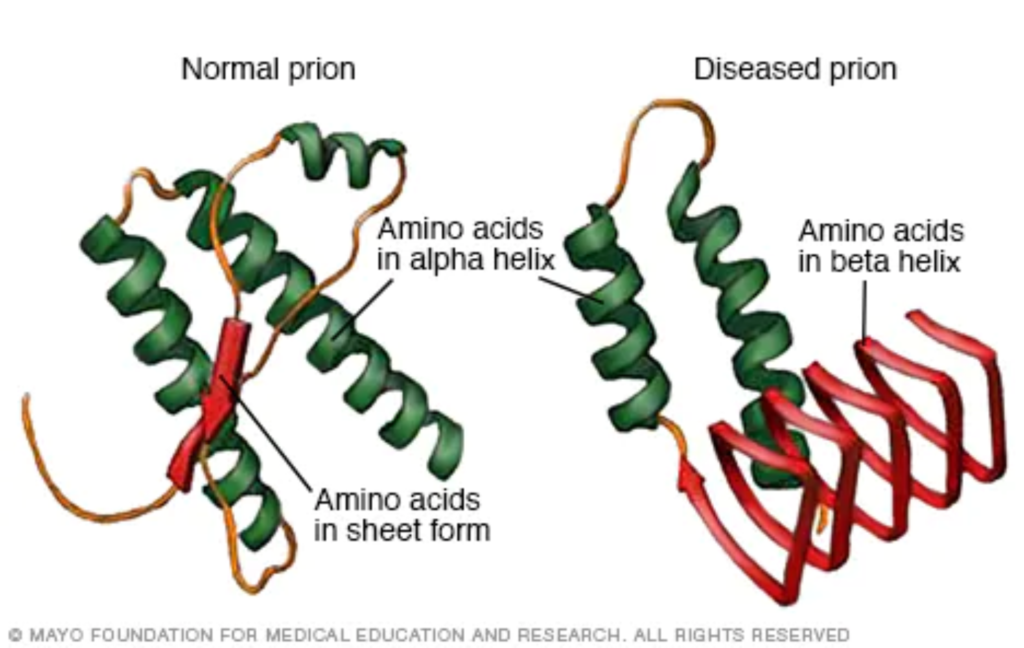
Faulty proteins in your brain known as prions cause CJD. Proteins are chemical molecules that need to hold a specific shape to work (like how a lock opens for a key with the right shape). Your cells can’t use proteins when they aren’t the right shape, and your body can’t break them down. With nowhere to go, those proteins slowly build up in your brain cells (neurons), ultimately damaging and destroying the neurons. When your body makes faulty proteins for any reason, those misshapen proteins can cause degenerative brain diseases, like Alzheimer’s disease.
Risk Factors
Most cases of Creutzfeldt-Jakob disease occur for unknown reasons. So risk factors can’t be identified. But a few factors seem to be associated with different kinds of CJD. Age, Sporadic CJD tends to develop later in life, usually around age 60. Onset of familial CJD occurs slightly earlier. And variant Creutzfeldt-Jakob disease (vCJD) has affected people at a much younger age, usually in their late 20s. Genetics, People with familial CJD have genetic changes that cause the disease. To develop this form of the disease, a child must have one copy of the gene that causes CJD. The gene can be passed down from either parent. If you have the gene, the chance of passing it on to your children is 50%. Exposure to contaminated tissue, People who’ve received infected human growth hormone may be at risk of iatrogenic CJD. Receiving a transplant of tissue that covers the brain, called dura mater, from someone with CJD also can put a person at risk of iatrogenic CJD. The risk of getting vCJD from eating contaminated beef is very low. In countries that have implemented effective public health measures, the risk is virtually nonexistent. Chronic wasting disease (CWD) is a prion disease that affects deer, elk, reindeer and moose. It has been found in some areas of North America. To date, no documented cases of chronic wasting disease (CWD) have caused disease in humans.
When to see a Doctor
Make an appointment with your doctor if you have any signs and symptoms that worry you.